Don’t get me wrong. The naturally-aspirated Porsche 911 is one cool ride. In fact, my buddy Tyler and I used to make U-turns just to do double takes on any Porsche 911 we passed. But it was always with the same intention—to see if the car carried the famed “Turbo” badge across it’s backside—a symbol even we knew meant serious business.
There’s just something about a 911 Turbo, new or old, that strikes a chord with sport’s car enthusiasts everywhere. The 911 nameplate is the second-oldest sports car nameplate in production (behind the Corvette), but it was the Turbo 911 that happened to be the fastest accelerating car on the planet when it charged on to the scene with 260Hp back in 1975. By 1978, the Turbo 911’s power had reached a neck-snapping 300-hp. Today, a new Turbo 911 will set you back at least 130k and take you to speeds that would end your driving career. The feeling is still the same. Any Porsche 911 bearing a Turbo badge equals respect.
That’s why Blown Vs Turbo is bringing you this guide to purchasing a 911 Turbo.
Porsche 911 3.0L (Turbo) 1975-1978

Ex-Steve McQueen 1976 Porsche 930 Turbo
The Classic 911 Turbo, marketed as the Porsche 930 here in the States, was built from 1975-1989. The car symbolizes everything Porsche is known for: distinctive body shape, wide wheel arches, large rear spoiler and legendary Porsche power.
How to Spot
- Wide wheel arches front and rear
- Whailtail rear spoiler with additional cooling vent
- Vinyl ‘shark’s fin’ protectors on leading edges of rear arches
- ‘Turbo’ Badge on rear
Things to Know
The 911 Turbo was available from with the Martini stripes as featured on Porsche racecars of the day. The so-called Martini Turbo was not a model in its own right. The stripes were simply an option.
In the USA, the very first 911 Turbos were badged ‘Turbo Carrera’. These first cars are still commonly known by their factory model number – ‘930’.
The Driving Experience
Driving an early 911 Turbo, although an experience in itself, might not be quite as exciting as you’ve built it up to be in your mind. As is the case with most 1980s turbo cars, the interior is dated, the engine feels sluggish at low revs and the steering feels flat out heavy. And did I mention turbo lag?
The joke goes your clothes could go out of style waiting for the single KKK turbocharger on the 911 Turbo to kick in—but when it does you’re in for a wicked ride.
The situation doesn’t improve much when it comes to handling as the car’s turbocharged engine sits even further back behind the wheels than a normally aspirated 911. Take a corner too fast and you’ll find yourself in a spin before you know what hit you. Even the brakes are a bit underwhelming for a car of this power.
The good news is you’re in a 911 Turbo—a car whose image is just as, if not more famous than its performance. So sit back and enjoy the look on people’s faces as they eye down those massive wheel arches and whaletail, straining to see that oh-so-important Turbo badge.

Porsche 911 3.3L (Turbo) 1978-1983

1983 Porsche 911 Turbo
In 1978, Porsche decided it was time to fix the mistakes it had made on the original 911 Turbo. To start, they dropped in a bigger 3.3L engine, achieved through an increased bore and stroke. Compression jumped up to 7.0:1, larger main and big-end bearings were used and an intercooler was added. The intercooler in conjunction with the engine cooling fan dropped air entering the engine by as much as 140 degrees Fahrenheit (60 degrees Celsius). The result was 40 additional horsepower putting the car at 300 hp.
But the improvements didn’t stop there. The original 911 brakes, which had been lifted off the earlier 911S, were replaced with brakes off the 917 racecar. Talk about improvement! The brakes were roughly 20mm bigger and substantially thicker. This combined with four-piston aluminum calipers and larger pads helped eliminate stopping problems.
On the outside, the Turbo received minimal changes, the most notable being the revised rear wing. The whailtail was redesigned to make room for the intercooler and received the nickname “teatray” due to its flat top, upturned sides and “boxed in” underside.
On the inside, the car finally received a boost gauge to help the driver plan for the long-awaited turbo kick.
How to Spot
- Boxier ‘teatray’ rear spoiler
- Boost gauge on dash
- Intercooler atop engine
- Larger brake discs and calipers
Things to Know
In 1980, the 911 Turbo was withdrawn from the US and Japanese markets because of issues with emissions regulations.
The revised whailtail on the 3.3L 911 Turbo is by far the most popular of all the Porsche tails. For this reason, many owners have installed the “teatray” whailtail on other versions of the 911.
The Driving Experience
The 3.3L 911 Turbo is about what you’d expect—a faster, better stopping car than the 3.0L 911 Turbo. Improved power resulted in a .2 second drop in 0-60 times and .4 seconds off quarter mile times. The top speed increased 9 mph to a very respectable 162 mph. Bigger, more powerful brakes meant shorter stopping distances and increased driver confidence.
Unfortunately, little was done in the way of handling and engine placement, and the car is still a handful if pushed hard into the corners. Also, turbo lag was still a major issue, although now the driver had a boost gauge to help plan for the onslaught of 300-hp.
Still, with all the improvements, what does this mean for Porsche enthusiasts? A safer, more fun, and a more desirable car than the original 911 Turbo.
Porsche 911 (Turbo) 1984-1989

1989 Porsche 911 Turbo Cabriolet
In 1984, Porsche updated the engine code, which was essentially the same engine, but featured new Bosch KE-Jetronic fuel injection and revised ignition timing. The result was a near 15 percent improvement in fuel consumption and reduced emissions.
The car also received a new exhaust system with a quieter wastegate setup—noticeable by twin tailpipes on the left-hand side of the car. The changes increased torque to 318 ft/lbs. Additional improvements to the interior including an updated heating system and fan control also occurred in 1984.
In 1986, the 911 Turbo received electric and heated front seats, central locking as a standard feature, heated washer jets, shorter shifter and additional leather trim for the door panels.
By 1987, the 911 returned to the US market and received an electronic engine management system to help pass US emissions regulations. The good news is the system, dubbed Motronic, worked with a new LE-Jetronic fuel injection system and electronic ignition to allow for improved efficiency and reduce emissions. The bad news is the US cars were down rated to 282-BHP and 287 ft/lbs of torque. Fail America. Other minor changes included a revised dash with larger air vents and front seats that sat 20mm lower on their mounts. Sixteen inch wheels became standard, up from 15-inch wheels, and the rear wheels grew to a width of 9-inches with 245/45VR tires.
For 1988, the Turbo came fitted with perforated brake discs, and in 1989, the car came standard with an eight-speaker stereo system and alarm.
But the biggest improvement for 1989 was the long-awaited five-speed transmission. It was based on the transmission used in the 3.2 Carrera, but featured stronger cases and modified gear ratios to handle the turbocharged engine.
How to Spot
- 16-inch wheels, 9-inches wide at rear (from 1987)
- Larger air vents in dash (from 1987)
- Whaletail’ rear spoiler
- ‘Turbo’ badge on rear
Things to Know
The 1989 models featuring the five-speed transmission are the most sought-after of the early Porsche 911 Turbos.
The Driving Experience
Increased torque made the car easier to drive considering the four-speed transmission.
Porsche 911 Turbo SE 1986-1989

1986 Porsche 911 Turbo SE (Slant-Nose)
In 1981, Porsche began to produce small numbers of its “slant-nose” 911 Turbos for its wealthy customers. This modification was usually carried out in one-off deals—that is until 1986, when Porsche decided to make the “slant nose” an official option (coded M506). This “slant nose” car was called the 911 Turbo SE (Special Equipment) in the UK and the 930S in the U.S.
The car carried some bite to back up its aggressive looks. The engine put out 330BHP, up 30BHP from the standard Porsche 911 Turbo. This was achieved through use of a larger KKK turbocharger, higher-lift camshafts, higher boost pressure, larger intercooler and an improved exhaust system. Porsche also offered a limited-slip differential as a no-cost option.
How to Spot
- “Slant nose” front end is impossible to miss
- Concealed pop-up headlamps
- Massive air vents behind headlights
- Massive air intakes right in front of the rear tires
Things to Know
The “slant nose”, despite its questionable styling, is often highly sought after due to its low production numbers and strong performance.
The Driving Experience
While many of the changes incorporated into the “slant nose” 911 Turbo were considered strictly cosmetic, the Increased power and unique styling make this an especially exciting early model Porsche to drive.
The 1980s are often referred to as the dark ages for many car manufacturers. Rising oil prices, a Cold War and questionable taste in music paved the way for anemic, oddly-shaped utilitarian cars, often known more for their shortcomings than for their performance.
But we must not forget that the 1980s also produced, as a result of Group B racing regulations, some of the most amazing supercars ever created. Group B called for few restrictions on technology and design, allowing manufacturers to focus on building high-tech, lightweight, turbocharged race cars capable of producing ridiculous amounts of power. Sadly the ridiculousness of having car manufacturers spend nearly unlimited amounts of money to build obnoxiously powerful cars came to end after a series of fatal crashes led to the abolishment of Group B regulations in 1986.
But lucky for us, much of the technology that went into building cars for Group B ended up in the very cars we drive, or wish we drove today.
Ferrari F40
From the marque that defined legendary, here is a legend among legends: the Ferrari F40. Considered by many to be one of the greatest Ferrari cars of all time, the F40 is nothing short of spectacular. A commemoration to Ferrari’s 40th year, and Enzo’s final work—the car was proof to the world that Ferrari’s engineering prowess was unsurpassed. Boasting a 2.9-liter, IHI-twin-turbo V8 engine under 16 psi of boost, the car produced a staggering 478-hp, which when combined with it’s lightweight, aerodynamic body made the car not just brutally fast, but the world’s first road legal production car to break the 200 mph barrier with a proven top speed of 202 mph. In 2006, Amir Rosenbaum of Spectre Performance was able to take his F40 with small boost and air intake modifications to 226 mph during Bonneville Speed Week.
Specifications:
Peak Power: 478 hp @ 7000 rpm
Peak Torque: 426 lb-ft @ 4000 rpm
Curb Weight: 2,425 lb
0-60 mph: 3.8 sec.
Top Speed: 202 mph
Ruf CTR “Yellowbird”
Few cars carry a reputation as wicked as the Ruf CTR “Yellowbird”, and even fewer live up to it. But the CTR is one of only a handful of cars that might actually surpass its reputation in terms of performance. The CTR started life as a Porsche 911, but quickly became something much more dangerous. Ruf dropped in an enlarged version of Porsche’s 3.2 litre flat-six engine, fitted with a DME fuel-injection system that had been developed for Porsche’s 962 racecars, along with a pair of turbochargers and twin intercoolers. This combined with lightened body panels, and integrated roll cage, uprated suspension and braking systems, a five-speed Ruf-designed gearbox, polyurethane bumpers and a fender-mounted oil filler to make room for the intercooler on that side, made the car obnoxiously potent. Much attention was paid to the aerodynamics of the car, including a seam-welded body, filler panels for the door pillars and 935-style mirrors—resulting in an incredibly high top speed. In fact, within weeks of Ferrari’s F40 taking the top speed record, the Ruf CTR stole the show by posting a 211mph top-speed at the America’s Road & Track magazine’s little get-together at Volkswagen’s Ehra-Lessien test track in Germany. The CTR also got it’s nickname “Yellowbird” at the event, as photographers noted how the car’s bright paintwork stood out against the in the dull weather conditions.
Specifications:
Peak Power: 469 hp @ 5950 rpm
Peak Torque: 408 lb-ft @ 5100 rpm
Curb Weight: 2,579 lb
0-60 mph: 4.0 sec.
Top Speed: 211 mph
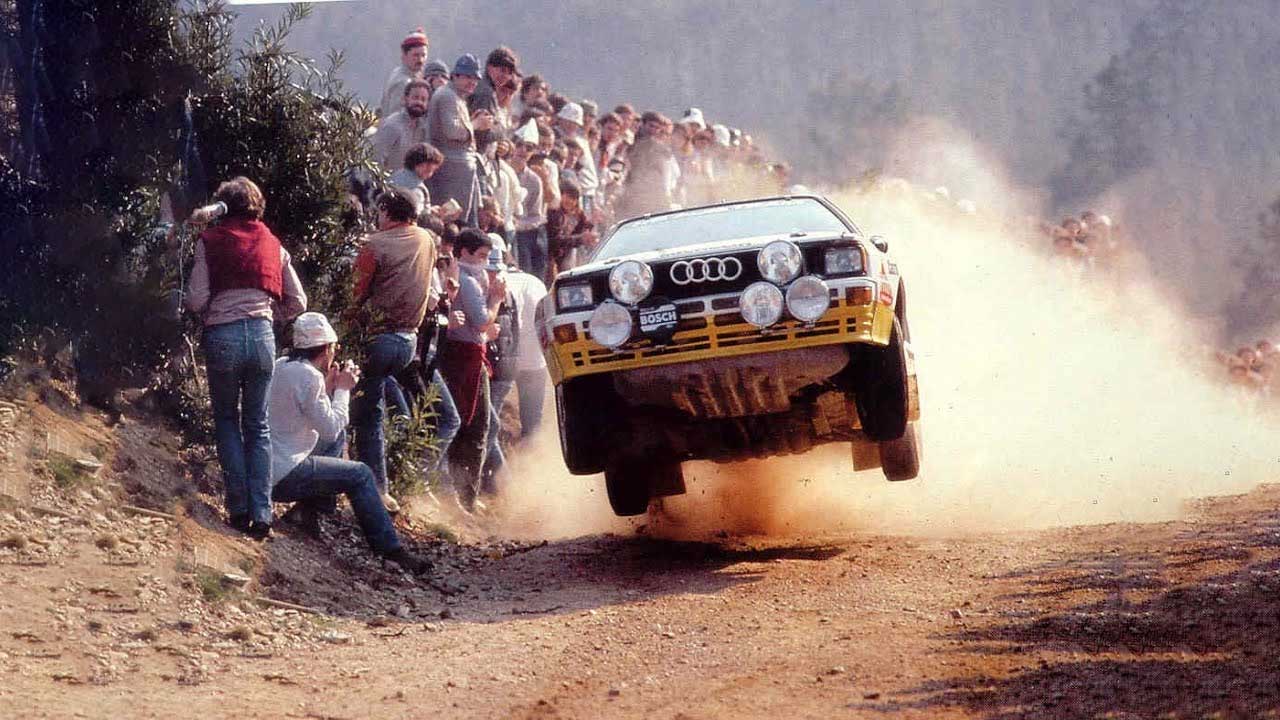
Audi Sport Quattro S1
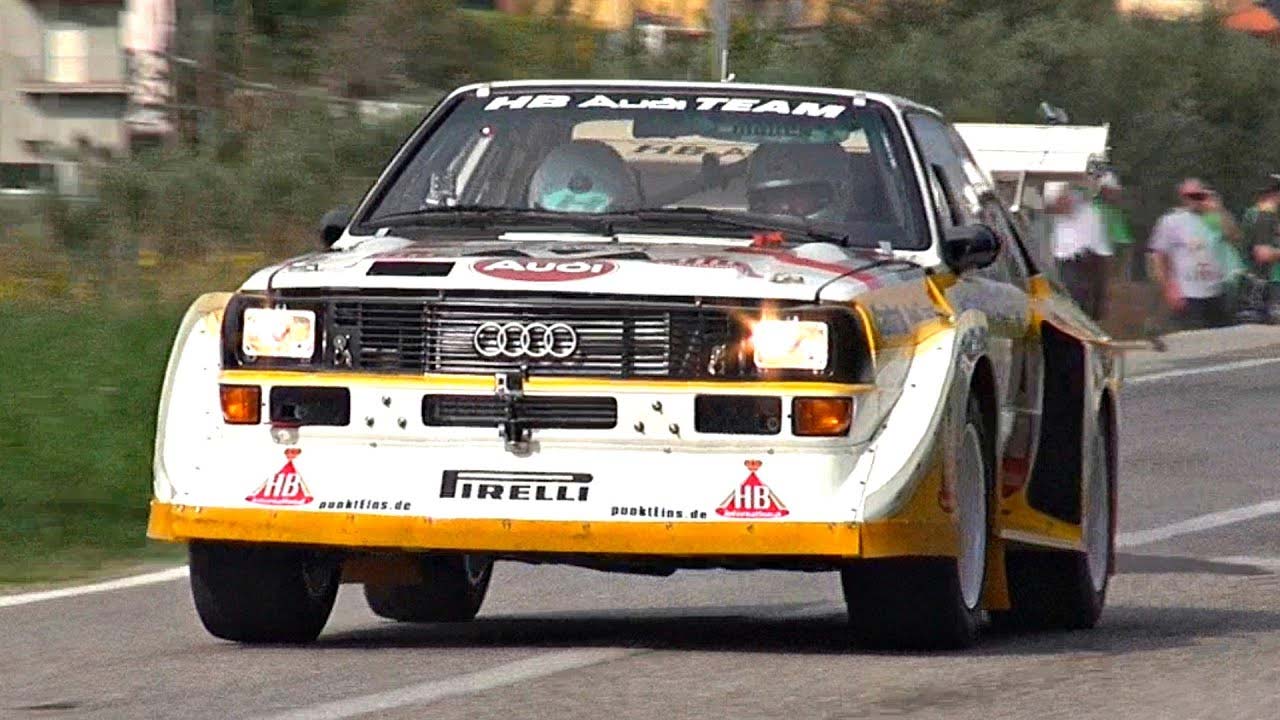
This car may very well define Group B. With more than 500hp on tap and a quattro permanent four-wheel drive layout, the car was an unstoppable force in rally racing. The car was powered by a 2,110 cc 5-cylinder engine paired with a turbocharger that featured a recirculating air system, allowing the car to maintain boost levels during cornering or while shifting. The car also featured a “power-shift gearbox” which is considered to be the forerunner of today’s Direct-Shift Gearbox (DSG) technology. The result: the most powerful rally car ever fielded in international competition. In 1985, the car won the Pikes Peak International Hill Climb with Michele Mouton at the wheel, setting a world record in the process. The car’s legacy was further cemented when the victory was repeated in 1987 with Walter Rohrl behind the driver’ seat.
Specifications:
Peak Power: 591 hp @ 8,000 rpm
Peak Torque: lb-ft @ rpm
Curb Weight: 2,403 lb
0-60 mph: 3.1 sec.
Top Speed: mph
Porsche 959
Produced from 1986 to 1989, the Porsche 959 was considered the most technologically advanced road-worthy sports car ever built. Featuring all-wheel drive, a 6-speed transmission and a turbocharged flat-6 engine, the car’s only real street-legal competition laid with the Ferrari F40. Much of what was learned from creating the 959, specifically in relation to engine management, aerodynamics and suspension tuning, is what has allowed the production life of the 911, which at one point was thought to be nearing obsolescence because of the extreme rear-engine placement, to continue on to present day. One of the most famous Porsche 959s is the Gates 959. The car was imported by Bill Gates to the US in 1987, but was stored for 13 years by the US Customs at the Port of Seattle, until regulations were changed to allow “Autos of Interest” to be imported.
Specifications:
Peak Power: 450 hp @ 6,500 rpm
Peak Torque: 369 lb-ft @ 5,500 rpm
Curb Weight: 3,197 lb
0-60 mph: 3.6 sec.
Top Speed: 197 mph
Ford RS200
One of the less well known sports cars of the 1980s, the Ford RS200 was produced from 1984 through 1986. The Group B Rally car version of the car featured all-wheel drive, a Bosch Motronic engine management system, fuel injection and a Garrett T3 turbocharged straight-4 engine boasting a mind-blowing 23 psi of boost. The result was acceleration so staggering that the “Evolution” variant of the RS200 was said to be able to reach 60 mph in 2.1 seconds, while the standard version clocked in at 2.8 seconds—numbers that would embarrass even today’s best accelerating cars.
Specifications:
Peak Power: 450 hp @ 8,000 rpm
Peak Torque: 361 lb-ft @ 5,500 rpm
Curb Weight: 2315 lbs
0-60 mph: 2.8 sec.
Top Speed: mph
Ferrari 288 GTO Evoluzione
The 288 GTO Evoluzione, designed by Pininfarina, is often considered the visual link between the 288 GTO and the F40. Of the five cars that were built, only three still exist today. The car produced approximately 650hp thanks in part to twin IHI turbochargers and 2 Behr intercoolers and weighed in at a mere 2,072 lbs making it both more powerful and lighter than the legendary F40. Not surprisingly the five-speed car also featured a higher top-end with a claimed top speed of 225 mph.
Specifications:
Peak Power: 650 hp @ 7800 rpm
Peak Torque: 492 lb-ft @ 4800 rpm
Curb Weight: 2,072 lb
0-60 mph: 4.0 sec.
Top Speed: 225 mph
Lotus Esprit Essex Turbo
Though the Lotus Esprit Essex Turbo is far from being the most powerful car on this list, it is one of the most iconic turbo cars of the 1980s with it’s unmistakable wedge shape and James Bond beginnings. The car became the first factory turbocharged Esprit in 1980 and featured a turbocharged dry-sump type 910 engine producing 210 hp and 200 lb ft of torque. The Essex cars came fitted with a Giugiaro-designed aerodynamic kit complete with rear lip spoiler, louvered rear hatch, bumpers, deeper front airdam and air ducts in the sills just ahead of the rear wheels. Only 45 of the Essex cars were built, and a copper-colored Esprit was featured in the James Bond movie For Your Eyes Only.
Specifications:
Peak Power: 210 hp @ 6250 rpm
Peak Torque: 200 lb-ft @ 4,500 rpm
Curb Weight: 3,052 lb
0-60 mph: 5.4 sec.
Top Speed: 153 mph
Test Post
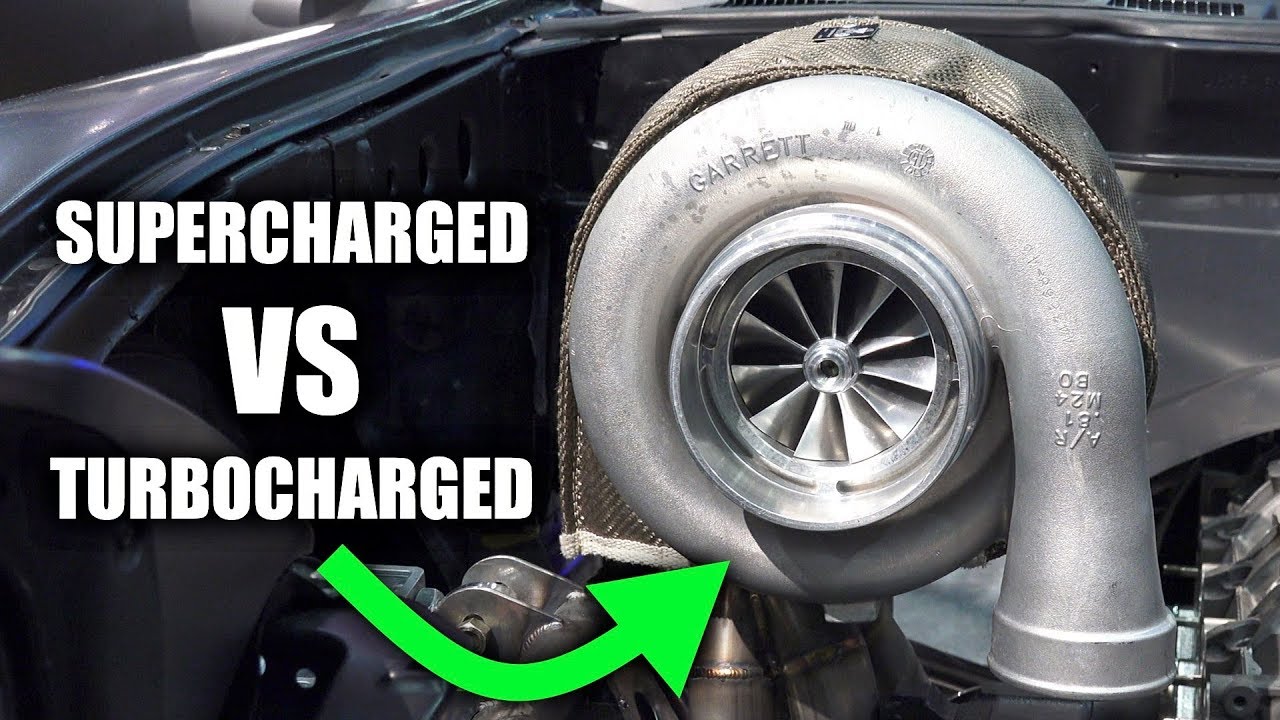
One of the most confusing aspects of superchargers is the word itself. The word is defined as follows: an air compressor used for forced induction of an internal combustion engine.
By this definition, even turbochargers, which happen to be turbine-driven superchargers would fit the description. But for sake of simplicity and as it applies to cars, we’ll define a supercharger as any pump driven directly by the engine, such as by belt and pulley, whereas turbochargers will be defined as pumps driven by pressures of the exhaust gases.
Types of Superchargers
There are a number of “supercharger” types available for internal combustion engines. For the most part, these superchargers fall into the following two categories: